
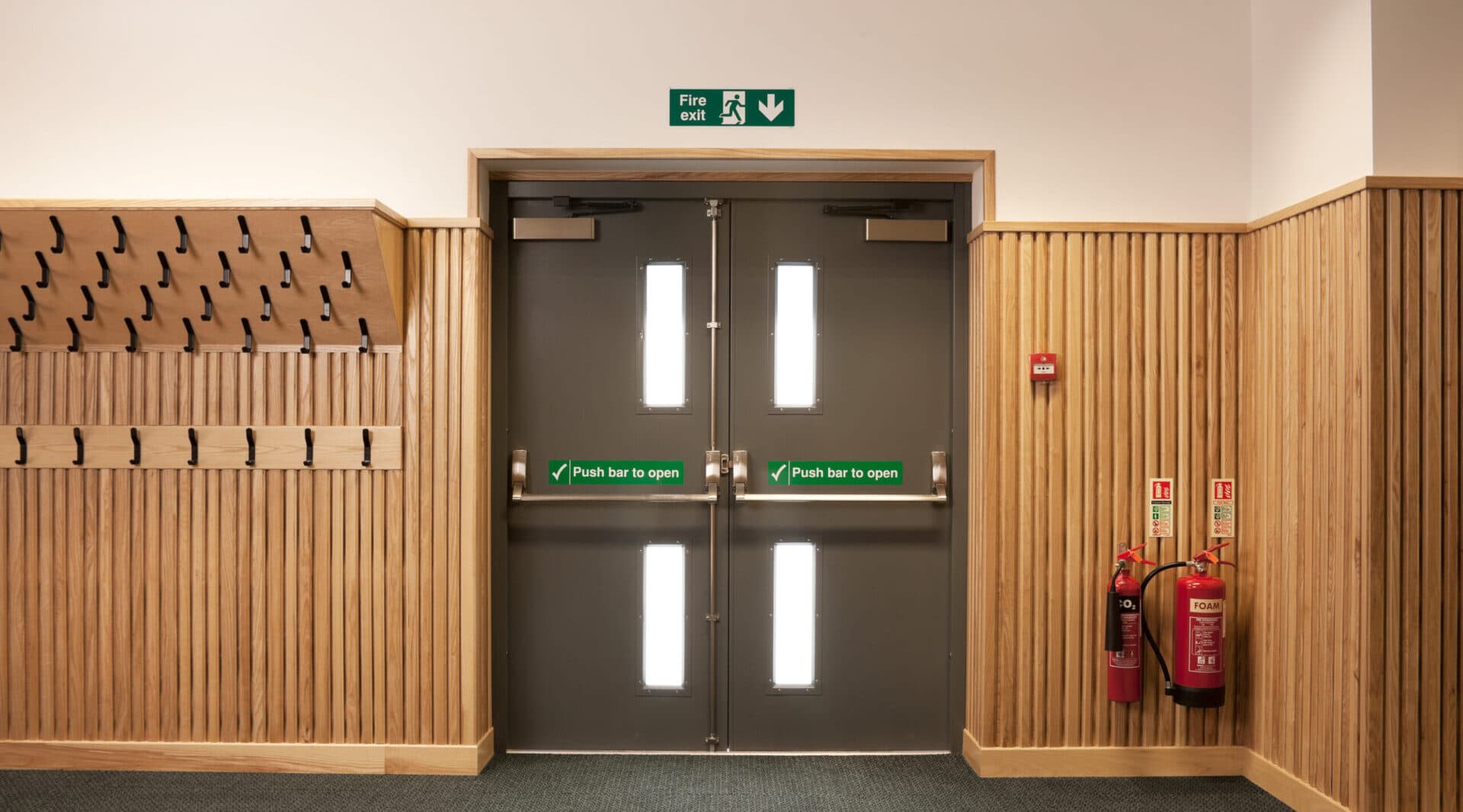
Steel doors are a critical part of a building’s fire safety strategy. However, in UK commercial and industrial premises, fire-resisting (fire-rated) steel doors and fire exit (final exit) doors serve different functions. Understanding the distinction helps you meet duties under UK fire safety law, satisfy insurers, and—most importantly—protect life.
This guide covers the difference between fire-resisting and fire exit doors, relevant UK legislation and standards, fire door testing and certification basics, exit hardware compliance (BS EN 1125 & BS EN 179), best practice for selection, installation and maintenance.
Fire Exit vs Fire-Resisting Steel Doors: What’s the Difference?
Fire-Resisting Steel Doors (Fire Doors)
Fire-resisting doors are part of a building’s passive fire protection system. Their purpose is to compartmentalise the building, slow the spread of fire and smoke, protect escape routes (e.g. protected corridors and stairways), and protect structural elements and high-risk areas.
They are normally tested and supplied as a complete doorset, meaning certification applies to the specific combination of door leaf, frame, hinges, closers, intumescent and/or smoke seals, glazing system (if fitted), and latches, locks and ironmongery as tested.
Common Fire Ratings: FD30 (30 minutes), FD60 (60 minutes), FD90 (90 minutes), FD120 (120 minutes). Steel fire doors can achieve higher ratings, including up to 240 minutes.
Fire-resisting doorsets are commonly tested to BS EN 1634-1 (fire resistance tests for door and shutter assemblies) and BS 476-22 (fire resistance of non-loadbearing elements).
Fire Exit Doors (Final Exit Doors)
A fire exit door is intended to allow occupants to leave to a place of safety. Its primary function is to enable quick and safe escape in an emergency. A fire exit door does not automatically require a fire-resistance rating.
Escape doors should open in the direction of escape where necessary, be readily openable from the inside without a key, not require specialist knowledge to operate, and not be obstructed.
Typical locations: final exits on the building perimeter, exit doors at the end of escape corridors, ground-level exits from protected stairways.
Exit Hardware: What’s Required
BS EN 1125 – Panic Exit Devices
Used where panic situations may be foreseeable: buildings used by the public, occupants unfamiliar with escape routes, higher occupancy environments. Typical devices: horizontal push bar or touch bar ("panic bar"). Common in schools, retail premises, public buildings, entertainment venues.
BS EN 179 – Emergency Exit Devices
Used where occupants are familiar with the building, panic is unlikely, staff-only or controlled environments. Typical devices: push pads, lever handle emergency exit devices. Common in offices, warehouses, industrial premises.
Key Differences: Fire-Resisting vs Fire Exit Doors
Fire-Resisting Steel Door: Purpose is compartmentation and fire resistance. Fire rating required where specified. Evidence via tested and certificated doorset. Location on compartment lines, protected corridors, stair enclosures.
Fire Exit Door: Purpose is safe final escape. Fire rating only required if identified in fire strategy. Evidence via escape hardware standards (EN 1125 or EN 179). Location at final exit to open air.
UK Legislation and Legal Responsibilities
Regulatory Reform (Fire Safety) Order 2005: Applies to nearly all non-domestic premises in England and Wales. The Responsible Person must carry out and regularly review a fire risk assessment, provide safe means of escape, maintain fire precautions including fire doors, and keep appropriate records.
Building Regulations – Approved Document B: Sets guidance for means of escape, compartmentation, door swing requirements, and fire door performance.
Fire Safety Act 2021: Clarifies that fire risk assessments in multi-occupied residential buildings must consider external walls and flat entrance doors.
Selecting the Right Steel Fire Exit Door
Consider: 1. Occupancy Type (public → BS EN 1125, staff-only → BS EN 179). 2. Fire Rating Requirement (only if on compartment line or protected route). 3. Security Requirements (multi-point locking, PAS 24, Secured by Design). 4. Vision Panels and Glazing (fire-rated if on fire-resisting doorsets). 5. Finishes and Configuration (powder-coated RAL, double-leaf, bespoke sizes).
Installation, Inspection and Maintenance
Installation: Install as complete tested doorset, follow manufacturer instructions, maintain correct gaps and seal continuity, use only approved compatible hardware.
Inspection and Maintenance: Six-monthly inspections commonly adopted. Checks include: seals intact, door closes fully onto latch, closer operates, hinges secure, no unauthorised alterations, no significant damage.
Frequently Asked Questions
Do all fire exit doors need to be fire-rated? No. Only if required by the building’s fire strategy or risk assessment.
Can a steel fire doorset also meet PAS 24? Yes, provided the doorset is certificated for both fire resistance and security performance.
How often must fire doors be inspected? Inspection frequency should be risk-based. Six-monthly checks are common in many non-domestic premises.
Conclusion
For UK businesses, understanding the difference between fire-resisting steel doors and fire exit doors is essential for compliance and life safety. Fire-resisting doors protect escape routes through compartmentation. Fire exit doors provide safe final egress. Both must be correctly specified, properly installed and regularly maintained.

